
So Who Is BabySlow?
People take one look and figure she’s AI. They look for the trick. They can’t find it. BabySlow really does dance, she posts every day, and a thousand views earn her a few cents. From Kempelen to Barnum, a short investigation into the curious case of a doll who has to prove she exists.

I came across someone who calls herself BabySlow entirely by accident, while looking on YouTube for something quite specific that I never did find. Nothing and no one usually holds my attention in that stream of shorts. It all seems to slip away, spooling out through the bottom of the screen. This one stopped me. I couldn’t tell whether someone was actually performing the dance or whether an AI had dreamed it up.
Oh, Great. More AI.
In 2026, the first impulse is to assume you’ve stumbled on yet another AI video, a cut above the usual fare. You play it again, and now you’re in the loop. She has the face of a porcelain doll and the look of a vamp out of a cyberpunk manga. Her brow creases, her nose scrunches up, and there’s a warmth to her smile that the generators still can’t quite manage. Her movements, meanwhile, are perfectly mechanical. Watch the little folds of skin at her hips as she turns. That looks like a real body. AI gives you flawless skin. Hers has a flaw or two.
Playing the Automaton
The caption and the hashtags settle it. The dancer says so herself. BabySlow isn’t AI. She’s human, she says, and would you look at how well she can imitate robots, automatons, and dolls? Her name is Wang Chen’er (王宸尔). She’s Chinese, lives in Osaka, and specializes in popping and jazz dance. We duly marvel. The technique! The control! Imagine the hours!
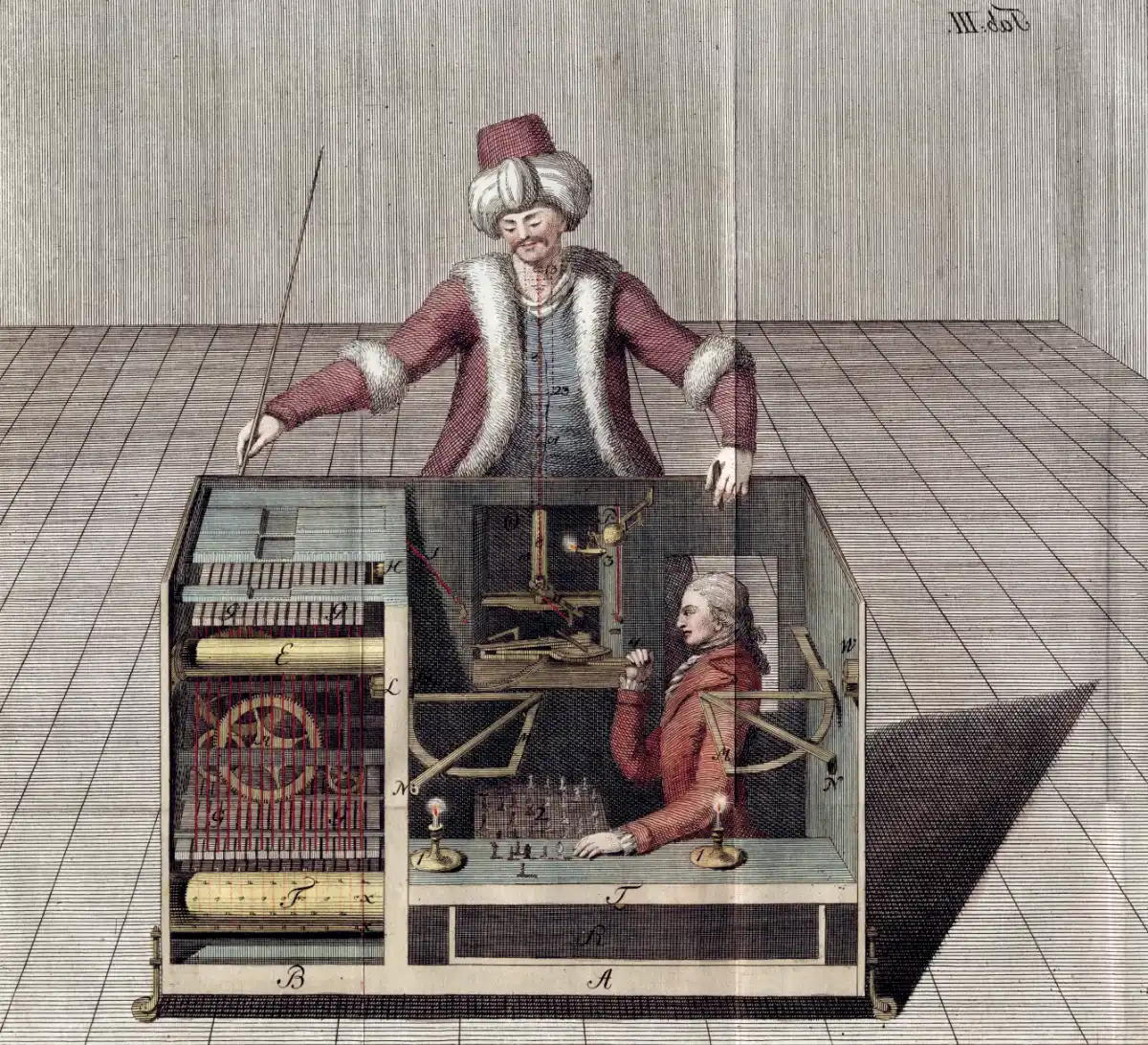
The act has a pedigree. In 1770, Wolfgang von Kempelen presented the Viennese court with a chess-playing automaton known as the Turk. A human chess player was concealed inside its cabinet. BabySlow turns the eighteenth-century arrangement inside out. The Turk was a machine with a man hidden inside. She’s a woman whose audience suspects there’s a machine in there somewhere, or at the very least that she’s had a little help from one.
So What’s the Trick?
Now comes the second impulse. Nobody looks that much like a machine without a trick somewhere. You watch one short after another. You think you spot missing frames, slow motion, a bit of sped-up footage, a smoothing filter. You consult a language model or two, hand over some screenshots, have the footage picked apart frame by frame. We’ll catch her in the act yet, this darling little doll who claims she’s only doing an impression. By now you’re almost hoping to uncover the sizable crew, the studio makeup, the small army in postproduction.
In Humbug (1973), his book on Barnum, the historian Neil Harris gave this particular pleasure a name. He called it the “operational aesthetic.” The New Yorkers who lined up to see the Feejee Mermaid in 1842 paid for the pleasure of figuring out how it had been made. The viewer in 2026 pays in watch time. Bring a critical eye, nurse your doubts, fall for the whole thing, troll the comments. It all looks the same to the platform. The term is “retention,” and with any luck it can be monetized.
It’s All Real
The AIs and AI-assisted tools I consulted, some with considerable nerve, others with an almost servile show of caution, agree on an exasperatingly ordinary verdict. In the clips they examined, they found no fiddling with playback speed, no morphing, no missing frames. Every so often a frame repeats, probably a quirk of the encoding. That leaves the makeup, ingenious and highly effective, but well within the reach of a stage performer. The accessories could have come straight out of cosplay. The lighting is consistently good, the kind of thing you can do with two or three well-placed lights. A key, a fill, a rim light, and you’re there. As for the soundtrack, whether it’s AI-generated or lifted from the sort of hit that does well on TikTok, what could be more ordinary?

By now we’re counting blinks. About twenty a minute, close to the average for an adult at rest, roughly seventeen according to Bentivoglio and colleagues. Only five are performed in “robot doll” mode. Carried along by the story and the staging, the viewer remembers those five and comes away convinced that her eyes never moved. A conjurer could hardly ask for a better illustration of the trade. Steer the eye, give it something to fix on, and one detail fills the frame.